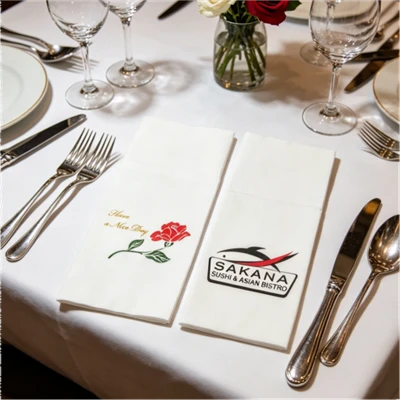
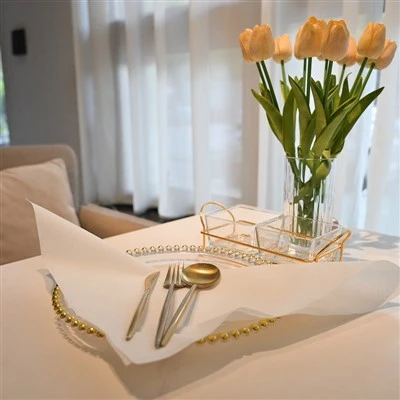
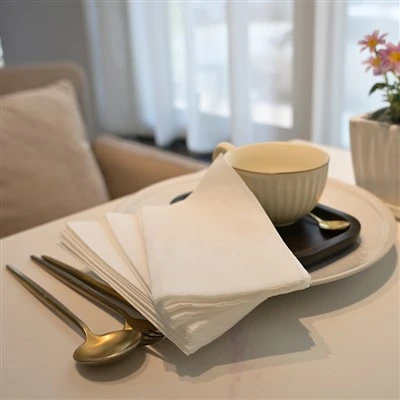
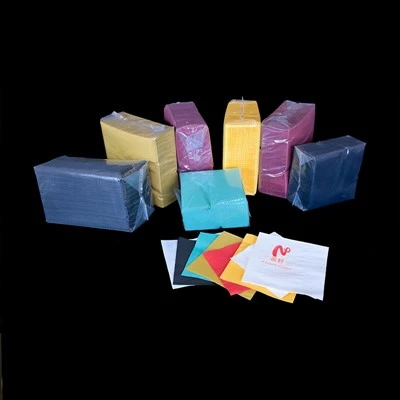
Napkin folds are classified by their visual appearance into categories such as animals, plants, and miscellaneous shapes. Based on the folding method and the specific dining ware used for placement, they are further divided into cup folds, plate folds, and ring folds. Cup folds possess a strong three-dimensional quality and realistic appearance; they are frequently used in Chinese-style table settings, though they carry the risk of soiling the glassware. Plate folds employ a hygienic and simple technique-allowing them to be prepared in advance-and are widely utilized in both Chinese and Western restaurants. Ring folds are traditional, simple, and elegant, making them a popular choice for banquet table settings.
The fundamental techniques for napkin folding include basic folding, pleating, rolling, flipping and pulling, pinching, and tucking. Basic folding is the most fundamental technique in the art of napkin folding. Pleating is a specific technique applied when creating folds or creases. Rolling involves coiling the napkin into a cylindrical shape. Flipping and pulling entails turning over or drawing out specific sections of the napkin-after it has been folded or rolled-to form the desired pattern. Pinching is primarily used to shape the heads of birds or animals. Tucking refers to the use of a tool to thread through the layered seams of the napkin, gathering the fabric as it passes through to create ruffled textures.
The selection and application of napkin folds should generally be guided by factors such as the nature, scale, and formality of the restaurant or banquet; the season; and the religious beliefs and customs of the guests. When selecting cup folds for a banquet, the fold at the head table should be positioned slightly higher than the others. For large-scale banquets, simpler plate folds-which can be prepared in advance-are often the preferred choice. When hosting Japanese guests, it is advisable to avoid using lotus flower designs. For weddings, motifs such as roses, twin-blossom lotuses, and mandarin ducks are highly appropriate. For Christmas celebrations, designs such as Christmas boots or candles make excellent choices.
According to Western dining etiquette, the host should generally be the first to unfold their napkin. This action should be performed gently and gracefully. The correct placement involves unfolding the napkin-either into a double layer or a diagonal fold, with the folded edge facing toward oneself-and laying it across one's lap. If one needs to leave the table temporarily, the napkin should be placed on the seat of the chair or allowed to hang slightly over the edge of the table. Upon finishing the meal, the napkin may be placed casually on the table; it should 'not' be neatly refolded. The napkin is intended for wiping the mouth; it should never be used to wipe cutlery or to blot perspiration.
The primary functions of a dining napkin include: protecting one's clothing by being spread across the lap; wiping the mouth using the inner surface of the napkin; providing a discreet screen-for instance, to cover one's mouth while using a toothpick; and serving as a non-verbal cue-for example, the hostess unfolding her napkin signals the commencement of the meal, placing the napkin on the table signals its conclusion, and placing it on the chair seat signals a temporary absence.